
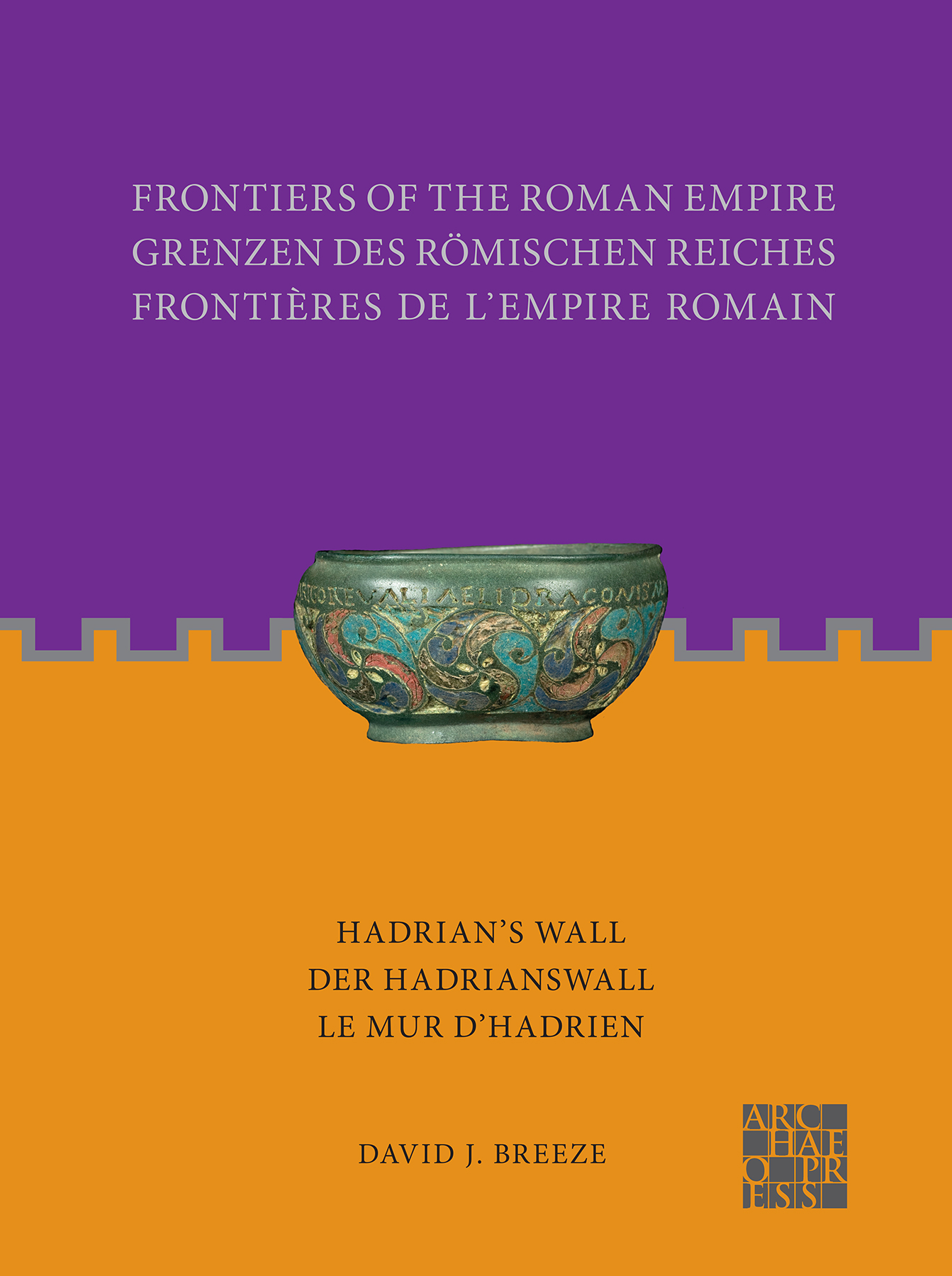
The frontiers of the Roman Empire together form the largest monument of one of the world’s greatest ancient states. They stretch for some 7,500 km through 20 countries which encircle the Mediterranean Sea. The remains of these frontiers have been studied by visitors and later by archaeologists for several centuries. Many of the inscriptions and sculptures, weapons, pottery and artefacts created and used by the soldiers and civilians who lived on the frontier can be seen in museums. Equally evocative of the lost might of Rome are the physical remains of the frontiers themselves. The aim of this series of books is not only to inform the interested visitor about the history of the frontiers but to act as a guidebook as well.
Emperor Hadrian ordered the construction of the great Wall which still bears his name ‘to separate the barbarians from the Romans’ (Historia Augusta, Life of Hadrian, 11). The complex of military installations, 117 km long, but with an extension without the linear barrier for about 40 km down the west coast, contained 74 km of stone wall, 43 km of turf rampart, 200 towers, 100 fortlets, 20 forts, took years to construct and was probably still being modified when Hadrian died in July 138. This highly illustrated book offers an accessible summary of Hadrian’s Wall, and an overview of the wider context of the Roman frontiers.
Contents
FRONTIERS OF THE ROMAN EMPIRE
Foreword by Francesco Bandarin
Preface by Jane, Lady Gibson
Common cultural heritage of the Roman Empire
The ‘Frontiers of the Roman Empire’ World Heritage Site
History and extent of frontiers
The army and frontiers
Research on Roman frontiers
Protection and presentation of frontiers
Future perspectives
HADRIAN’S WALL
The invasion and conquest of Britain
The first plan for Hadrian’s Wall
The second scheme
The purpose of Hadrian’s Wall
The military landscape
The later history of Hadrian’s Wall
Life on Hadrian’s Wall
Civilians on Hadrian’s Wall
Religion on Hadrian’s Wall
Souvenirs of Hadrian’s Wall
The afterlife of Hadrian’s Wall
The importance of Hadrian’s Wall
A World Heritage Site
Research on Hadrian’s Wall
The Pilgrimage of Hadrian’s Wall
Museums on Hadrian’s Wall
Where to see Hadrian’s Wall