
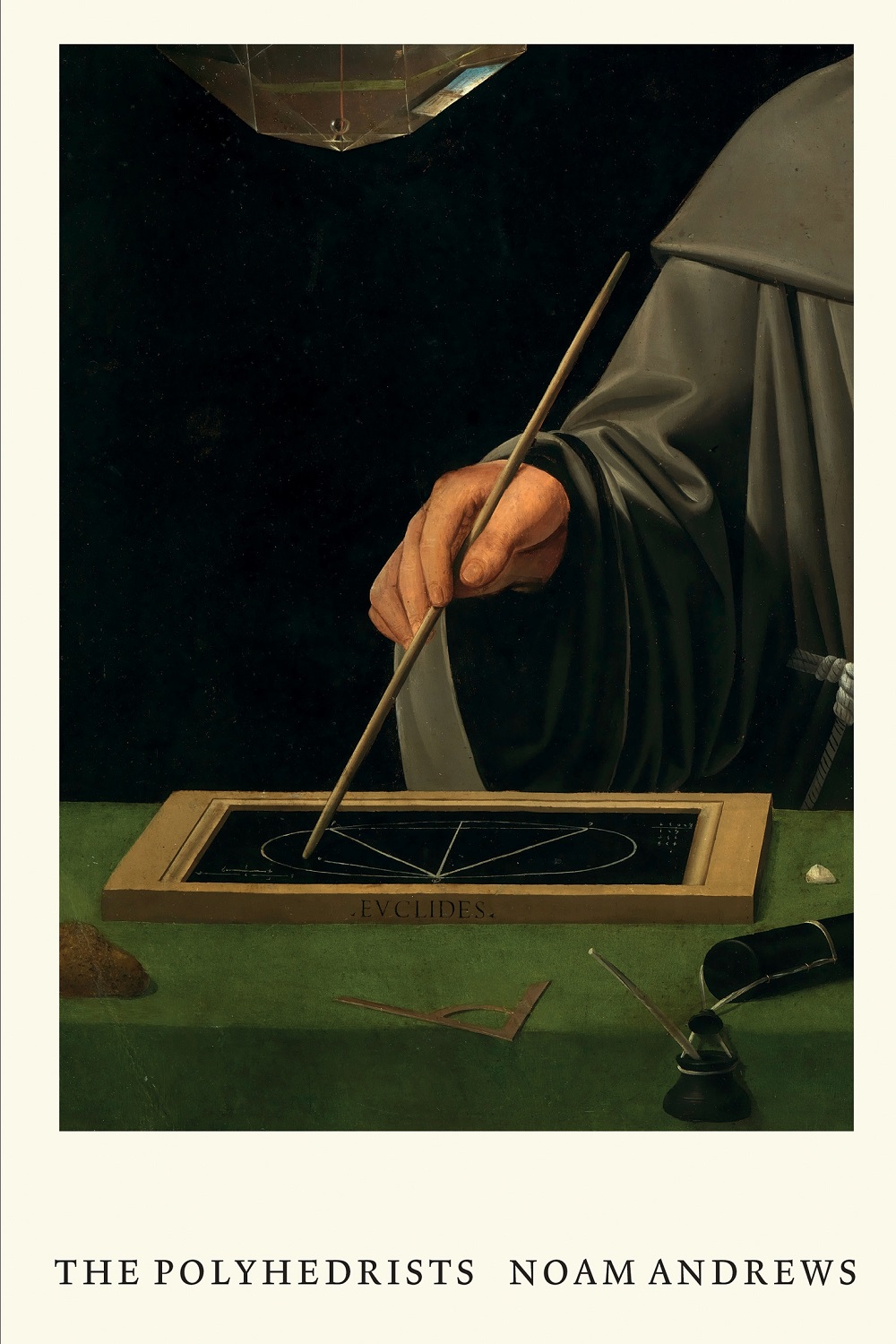
A history of the relationship between art and geometry in the early modern period.
In The Polyhedrists, Noam Andrews unfolds a history of the relationship between art and geometry in early modern Europe, told largely through a collective of ground-breaking artisan-artists (among them, Luca Pacioli, Albrecht Dürer, Wenzel Jamnitzer, and Lorentz Stöer) and by detailed analysis of a rich visual panoply of their work, featuring paintings, prints, decorative arts, cabinetry, and lavishly illustrated treatises. But this is also an art history of the polyhedra themselves, emblems of an evolving artistic intelligence, which include a varied set of geometrical figures--both Platonic, or regular, like the simple tetrahedron, and Archimedean, or irregular, like the complex yet beguiling rhombicosidodecahedron.
Moreover, The Polyhedrists argues that the geometrical depictions of Dürer, Jamnitzer et al. were far more than mere follies from the dawn of perspective, at odds with a contemporary view of the Renaissance, and destined to be superseded by later developments in higher level mathematics. In fact, the evolution of the solids into innumerable "irregular bodies" constituted a sustained moment in the formulation of Renaissance mathematical knowledge and its engagement with materiality. This intense field of experimentation would birth a new language of geometrical abstraction that would ignite a century of novel form-making strategies, ultimately paving the way for developments in geometry and topology in the nineteenth and early twentieth centuries, and even prefiguring the more recent digital turn. The book, in this sense, is not just an applied history of geometry, nor a particular geometric reading of early modern art through some of its more celebrated practitioners, but a manifesto of sorts into the hitherto unexplored wilds of art and science.