
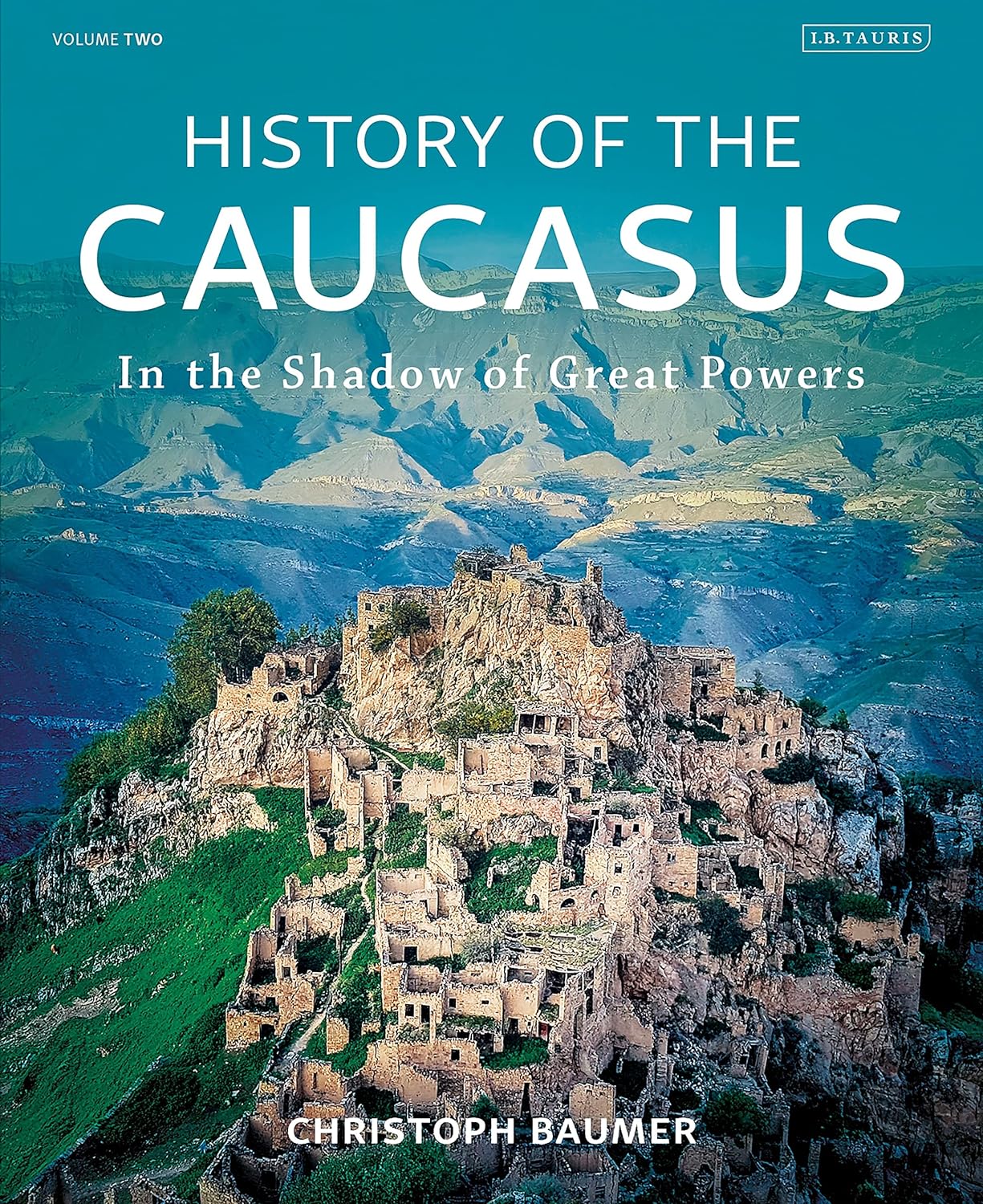
In the Shadow of Great Powers is the second volume of Christoph Baumer's History of the Caucasus. It covers the period from the Seljuk domination of the Southern Caucasus around 1050 CE to the present day. After the Kingdom of Georgia's golden age of independent power and cultural blossoming in the 12th and early 13th centuries, the Caucasus was overrun by the Mongols and soon disintegrated into innumerable smaller kingdoms, principalities and khanates. At the same time, an Armenian kingdom in exile maintained a precarious independence in Cilicia, today's southern Turkey, by applying a three-way diplomatic policy balanced between the Mongol Il-Khanate, the Crusader states and, to a lesser degree, the Mameluke Empire. Then followed four centuries during which the highly fragmented polities of the North and South Caucasus became political pawns of the regional great powers, above all the Ottomans, Iran and Russia.
In the wake of World War I the South Caucasus enjoyed a short-lived independence whereas its northern neighbours were engulfed by the Russian civil wars. But by 1921 the Soviet Union had re-established Russian dominance over the whole region and, from a Western perspective, the region 'disappeared' behind the Iron Curtain. Nevertheless, the Caucasian nations kept their pronounced identities even under Soviet rule, giving rise at the dissolution of the Soviet Union to a number of internecine conflicts. Whereas the Russian Federation managed to maintain its supremacy over the North Caucasus - albeit at the cost of bloody wars and insurrections - Armenia, Azerbaijan and Georgia succeeded in more or less gaining control over their destiny. Of these three republics, only Azerbaijan secured a wide-ranging independence thanks to its fossil fuel resources. Following Russian interference, Georgia lost control over two of its provinces while Armenia remains dependent on Russian support in the face of its notoriously antagonistic relations with neighbouring Azerbaijan and Turkey over the unresolved issue of Karabakh. In the Shadow of Great Powers includes some 200 full-colour images and maps which further bring the turbulent history of this region to light.
In the Shadow of Great Powers is the second volume of Christoph Baumer’s History of the Caucasus. It covers the period from the Seljuk domination of the Southern Caucasus around 1050 CE to the present day. After the Kingdom of Georgia’s golden age of independent power and cultural blossoming in the 12th and early 13th centuries, the Caucasus was overrun by the Mongols and soon disintegrated into innumerable smaller kingdoms, principalities and khanates. At the same time, an Armenian kingdom in exile maintained a precarious independence in Cilicia, today’s southern Turkey, by applying a three-way diplomatic policy balanced between the Mongol Il-Khanate, the Crusader states and, to a lesser degree, the Mameluke Empire. Then followed four centuries during which the highly fragmented polities of the North and South Caucasus became political pawns of the regional great powers, above all the Ottomans, Iran and Russia.