Products
Products
    • Total RON Comandă
      x
      Your cart is empty.
      Comandă
      ×

      Din cauza încărcării excepționale din această perioadă, există posibilitatea să apară mici întârzieri la livrare.

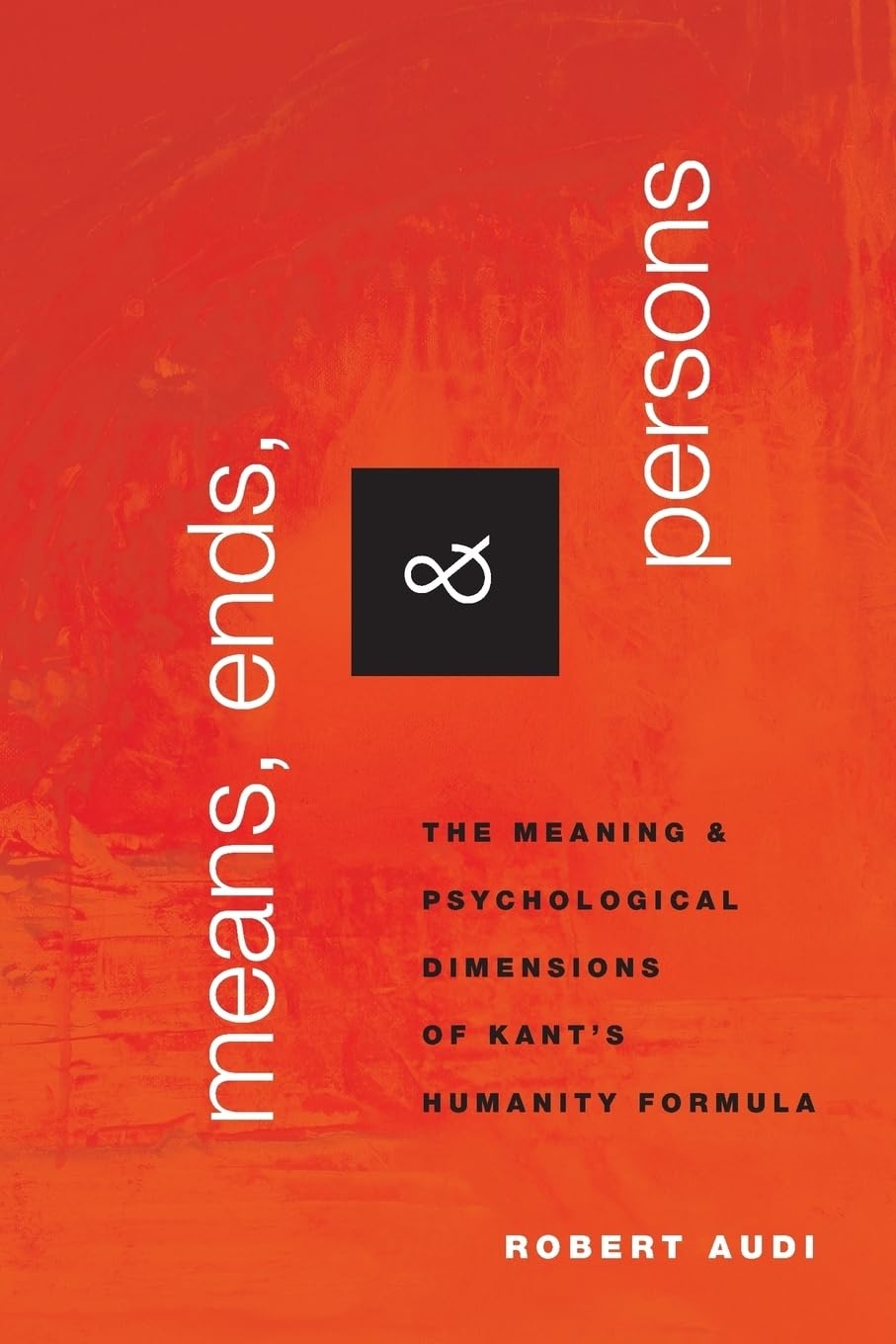
      Means, Ends, and Persons

      Means, Ends, and Persons

      The Meaning and Psychological Dimensions of Kant's Humanity Formula
      0.0 / 10 ( 0 votes)
      Language:
      Engleza
      Publishing Date:
      2018
      Cover Type:
      Paperback
      Page Count:
      192
      ISBN:
      9780190913748
      Dimensions: l: 14cm | H: 21cm | 1.5cm | 240g
      Add to cart
      26000
      Next Day Delivery! Limited
      Today by bike delivery
      Next Day Delivery!

      Price applicable only to online purchases!
      Free Gift Wrapping!
      Free shipping over 150 RON
      You can return it in 14 days
      You got questions? Contact Us!
      Publisher's Synopsis

      No one wants to be treated merely as a means-"used," in a sense. But just what is this repugnant treatment?

      Audi's point of departure is Kant's famous principle that we must treat persons as ends in themselves and never merely as means. Treatment of these kinds is conduct, a complex three-dimensional notion whose central elements are action, its motivation, and the manner of its performance. He shows how the notions of treating persons as ends and, by contrast, merely as means, can be anchored outside Kant and clarified in ways that enhance their usefulness both in ethical theory and in practical ethics, where they have much intuitive force.


      Audi constructs an account of treatment of persons-of what it is, how it differs from mere interpersonal action, and what ethical standards govern it. In accounting for such treatment, the book develops a wider conception of ethics than is commonly implicit in utilitarian, deontological, or virtue theories. These results contribute to ethical theory, but in its discussion of diverse narrative examples of moral and immoral conduct, the book also contributes to normative ethics. Audi's theory of conduct takes account of motivational elements that are not traits of character and of behavioral elements that are not manifestations of virtue or vice. Here it goes beyond the leading virtue approaches.

      The theory also advances rule ethics by framing wider conception of moral behavior-roughly, of acting morally. The results advance both normative ethics and ethical theory.

      For moral philosophy, the book frames conceptions, articulates distinctions, and formulates principles; and for practical ethics, it provides a multitude of cases that illustrate both the scope of moral responsibility and the normative standards for living up to it.

      Reviews and comments

      Nota

      de |

      There are no reviews yet for this product.
      Add a review
      You need to authenticate in order to add a review.