
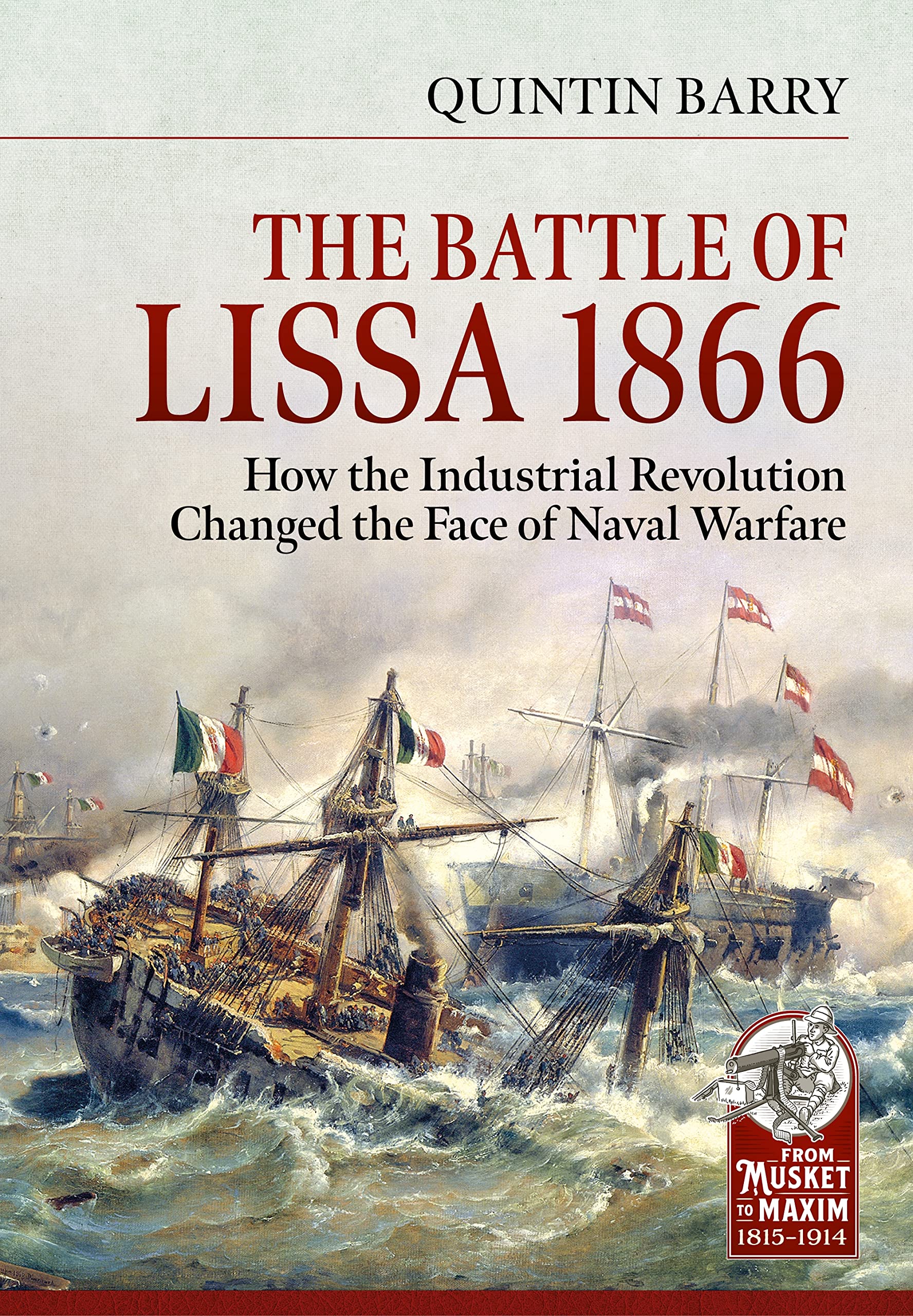
It has often been said that, so slow was the process of change in naval warfare, Sir Francis Drake would if he was transported to the quarterdeck of the Victory not feel out of place. Half a century on from the end of the Napoleonic wars, a total transformation had taken place in every aspect of naval warfare. As a result of the Industrial Revolution the ships that fought the battle of Lissa would have been unrecognizable to Drake.
The principal changes had been the introduction of steam power, of shell guns and of armor plating. The use of steam engines to power warships was substantially assisted by the invention of the screw propeller which quickly made paddle steamers obsolete. And the effect of shell guns was hugely increased by the development of rifled ordnance.
The Industrial Revolution came first to Britain, and it was here that the earliest experiments were made with steam engines as a vessel's motive power. The replacement of wood by iron as a shipbuilding material also came slowly, and both innovations faced considerable resistance from conservative opinion.
Once the Industrial Revolution spread through mainland Europe, it was often in France that important breakthroughs were made, though contrary to the opinion of earlier historians, the British Admiralty kept a close watch on technological progress. The outbreak of the American Civil War in 1861 powerfully accelerated developments in all aspects of warship design. As other navies adopted the latest technology it became apparent that the tactics of naval warfare must also change. In 1866 Italy, in alliance with Prussia, went to war against Austria, having built up a substantial fleet of ironclads. The Austrians, too, had also acquired a number of ironclads. The two fleets faced each other in a campaign in the Adriatic, in which the Italian fleet was led by Admiral Carlo Persano and that of Austria by Admiral Wilhelm von Tegetthoff. On July 20, 1866 they met in what was to be the first fleet action of the new age, and the encounter ended in a decisive victory for the Austrian fleet. Much of the blame for the Italian defeat was laid at Persano's door, while his opponent became a national hero.
This book is the first comprehensive account of the campaign of Lissa in the English language for more than a century. It explores the progress of naval shipbuilding and tactics in the period leading up to 1866, together with the development of the Italian and Austrian navies.