
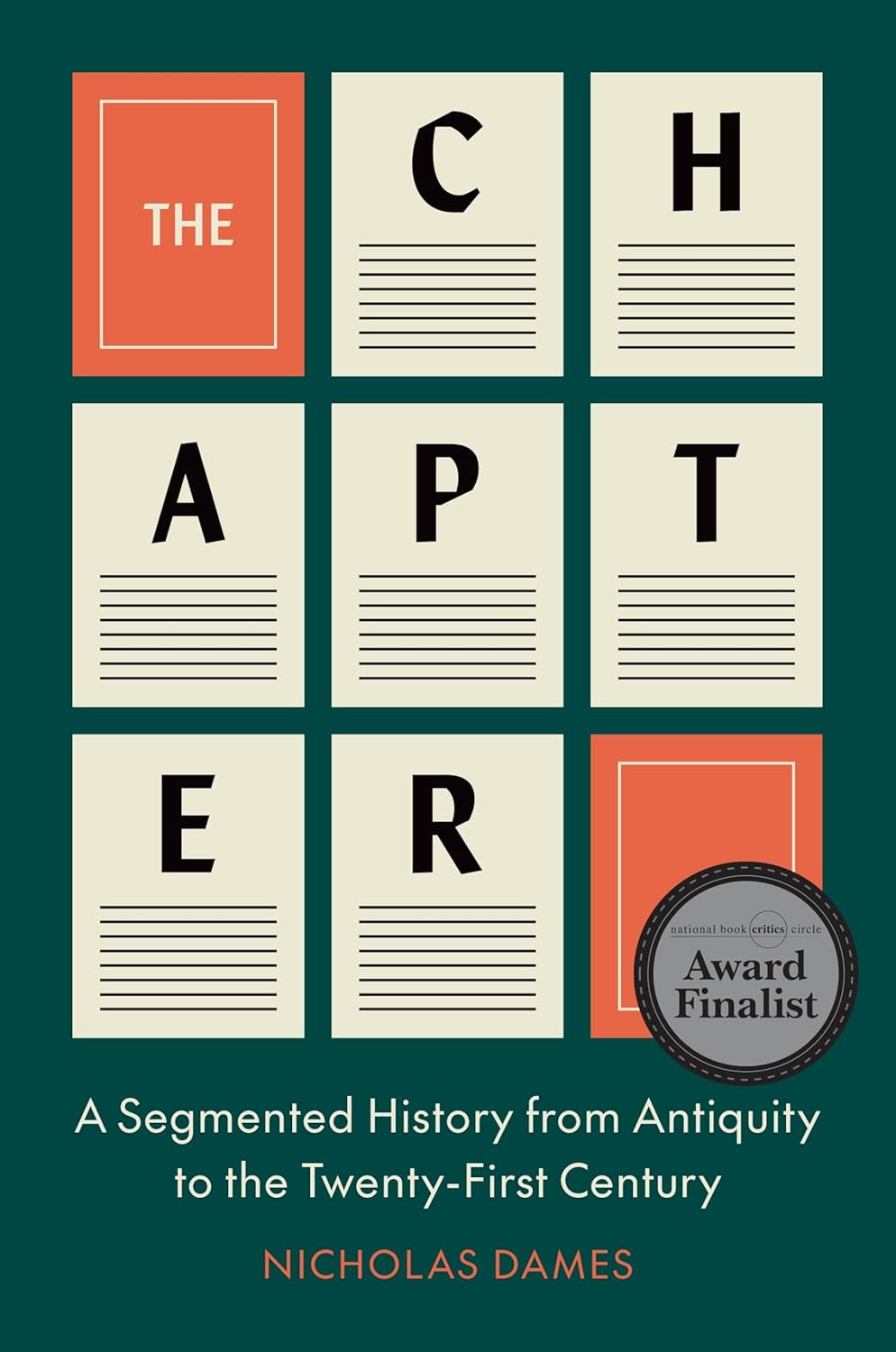
Finalist for the National Book Critics Circle Award in Criticism
Shortlisted for the Christian Gauss Award, Phi Beta Kappa Society
A history of the chapter from its origins in antiquity to today
Why do books have chapters? With this seemingly simple question, Nicholas Dames embarks on a literary journey spanning two millennia, revealing how an ancient editorial technique became a universally recognized component of narrative art and a means to register the sensation of time.
Dames begins with the textual compilations of the Roman world, where chapters evolved as a tool to organize information.
He goes on to discuss the earliest divisional systems of the Gospels and the segmentation of medieval romances, describing how the chapter took on new purpose when applied to narrative texts and how narrative segmentation gave rise to a host of aesthetic techniques. Dames shares engaging and in-depth readings of influential figures, from Sterne, Goethe, Tolstoy, and Dickens to George Eliot, Machado de Assis, B. S. Johnson, Agnès Varda, Uwe Johnson, Jennifer Egan, and La´szlo´ Krasznahorkai.
He illuminates the sometimes tacit, sometimes dramatic ways in which the chapter became a kind of reckoning with time and a quiet but persistent feature of modernity.